DIVINATION: Trust Not Your Process, Trust Your Process
Aki Goto
January 3—January 17, 2025
Psychic Readings by Marie 302 E 5th Street
Desnivel is pleased to present DIVINATION: Trust Not Your Process, Trust Your Process, an exhibition by Aki Goto, presented at Psychic Readings by Marie in New York’s East Village. This exhibition continues Desnivel’s exploration of alternative exhibition models and site-specific approaches, while acknowledging the East Village’s rich history as a center for artists, independent spaces, and small businesses.
Aki Goto is a contemporary multimedia artist born in Tokyo, Japan, who lives and works in the Hudson Valley, New York. Her practice encompasses video, sound, textile, drawing, painting, performance, and installation, and examines themes of presence, memory, parenthood, and the quotidian through conceptually driven, experiential frameworks.
In conjunction with the exhibition, Marie, the Psychic Reader, will offer tarot readings using a deck designed by the artist.
Thank you to EUROPA Gallery for the collaboration.
In 1974, the American conceptual artist Gordon Matta-Clark, with the aid of a few friends, took a chainsaw to the roof, walls, and interior of a condemned New Jersey home and split it down the center. Seen from the side in one black-and-white photo, the two halves of the house tilt away from each other. The structure looks paper-thin, weightless, and empty. The cut is ragged but uncompromising; a line that could have wiggled a few inches to avoid a second-story window instead breaks off one of its side jambs, exposing the glass pane’s naked edge. It is said that this split-up, since-demolished house represents the rupture in the myth of American modernism presaged by the fiscal conservatism of President Gerald Ford and the technocratic impositions of urban planners like Robert Moses, which foreclosed the utopian possibilities of the twentieth century before they could be fully imagined.
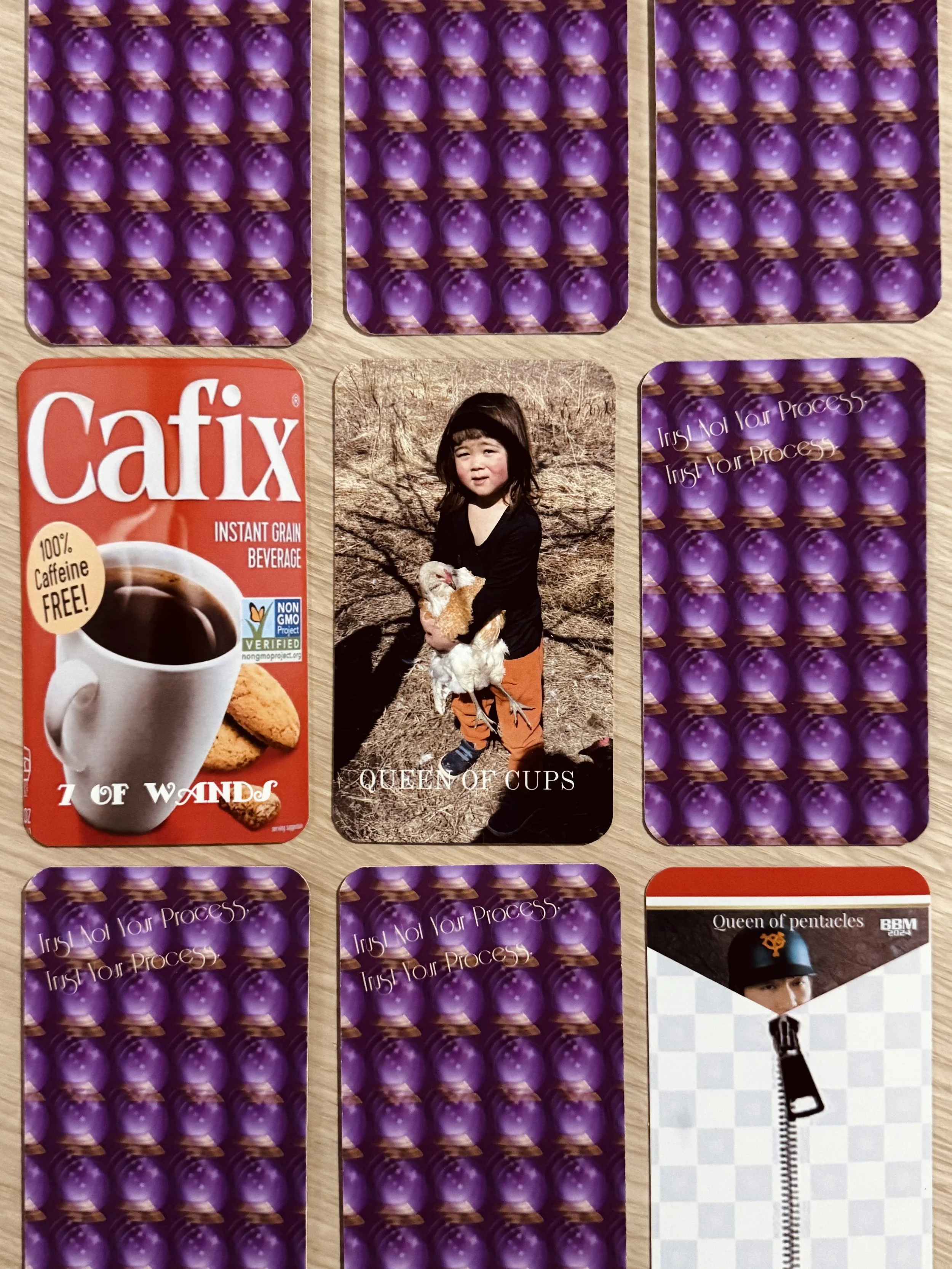
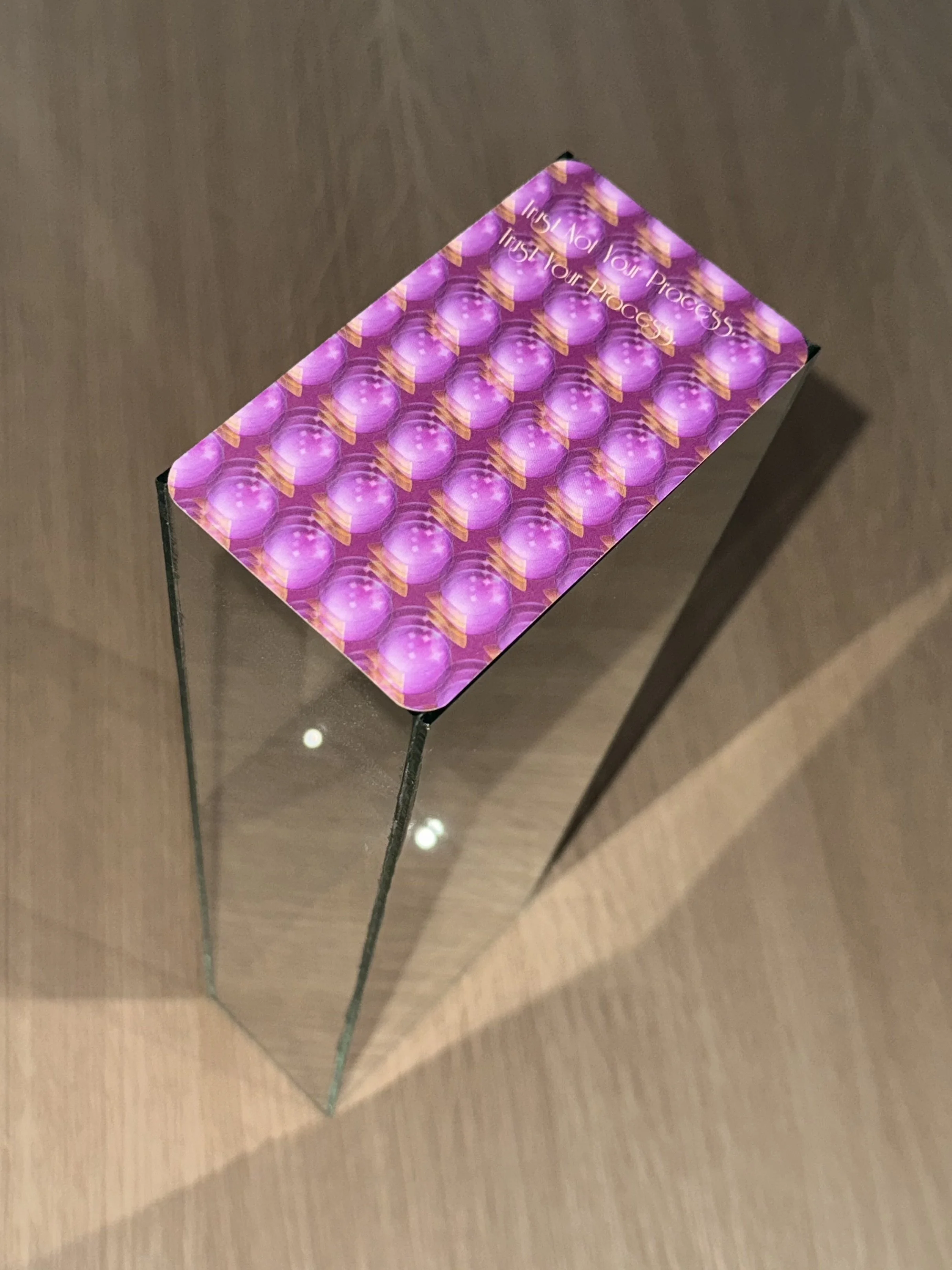
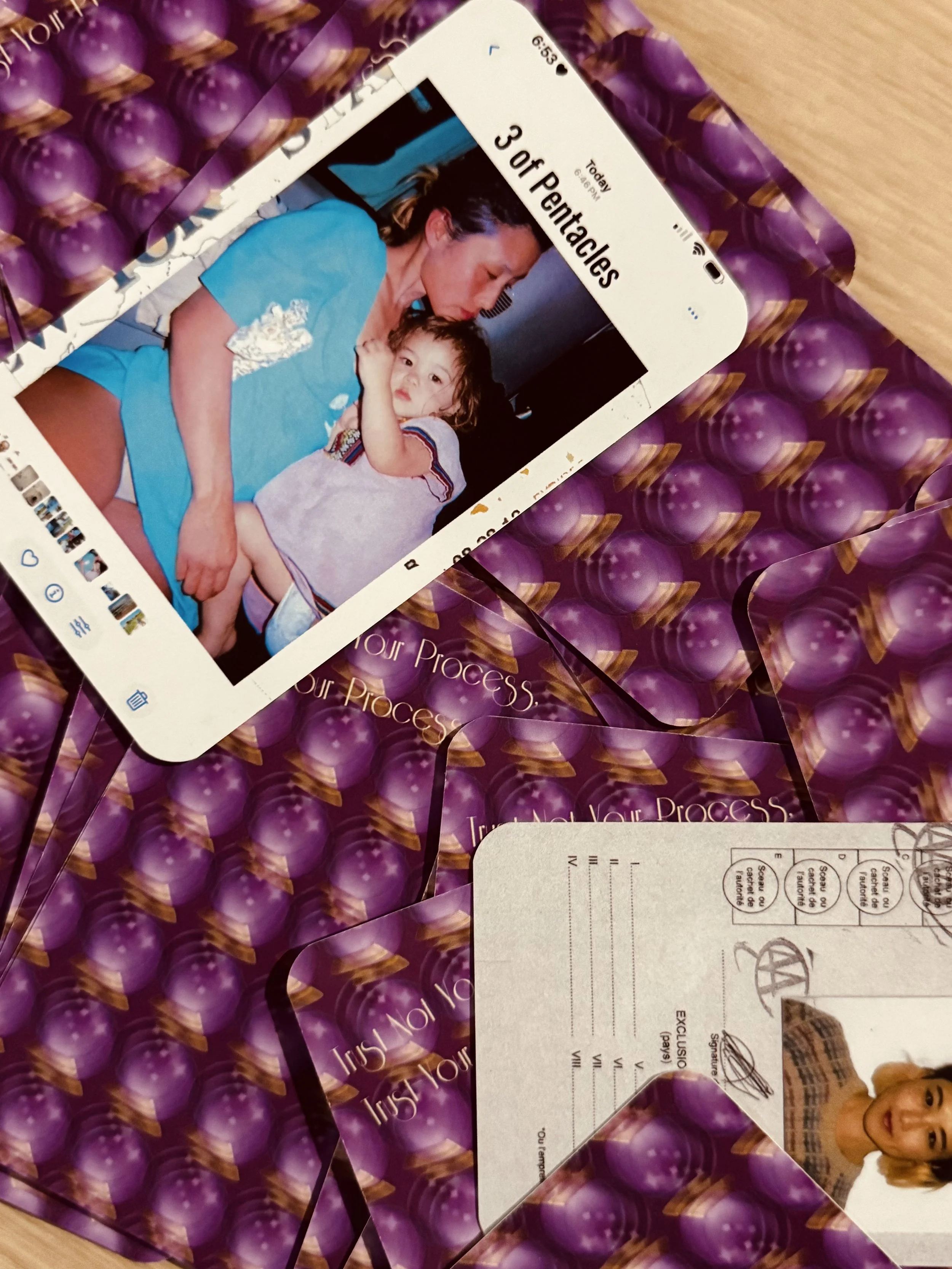
Suppose there had been a cup in the house – a wooden teacup lacquered black like the sweetest cherry. Suppose the cup carried sentimental value, that it had been a gift from a mother to a daughter, and say it had been cut such that it could no longer hold liquid but could still stand upright with some dignity. What I’m describing is an object affixed to the Strength card in Hudson Valley-based multimedia artist Aki Goto’s newly constructed tarot deck, Trust Not Your Process, Trust Your Process (2026). A no-nonsense hand – a machine, perhaps – has sliced through all the readymades that comprise her Major Arcana, ensuring that the objects adhere to the dimensions of the cards. Temperance is a small ceramic unicorn made by the artist’s daughter, Senka, that has lost its lower half; the intervention reveals its radish-white insides. A square tin filled with resin fish lies ajar on the card for Justice, the top edge of its lid lopped off. Part of a comic book – Dragon Ball Super, volume 1 – sits closed on the Death card, the ink on the cross-section of its pages grainy and striated like TV static.
Goto’s “slice” – the word appears all over the in-progress materials list she sends me while she works on her deck – is the aesthetic gesture that defines this body of work. It embodies a profoundly ordinary, acutely pragmatic state of fragmentation. After all, quotidian things are sliced: bread, ham. What escapes the orbit of the everyday must be pared, carved, incised, partitioned. Goto’s sliced object at times resembles a modernist fragment, but it is neither a fully melancholic trace nor a wholly haunted artifact. Nor does it symbolize a lost culture we must mourn. “The meaning of life is there is no meaning,” Goto told me with the utmost sincerity in Maria De Victoria’s East Village apartment last autumn.
In their obsolescence, Goto’s readymades speak of a world that has both broken from established traditions and jettisoned its utopian manifestos. Despite the artist’s insistence on meaninglessness, her sliced objects, sourced from her studio and home, seem impervious to irony. They fend off postmodern cynicism like protective charms. In Goto’s hands, these objects are deliberately damaged and – almost simultaneously – salvaged, transformed into portents foretelling a strange future. Grappling with Robert Rauschenberg’s flatbed picture plane in Other Criteria (1972), Leo Steinberg distinguished between the “Renaissance man” who “looked for his weather clues out of the window” and subjects of the twentieth century who “turn knobs to hear a taped message, ‘precipitation probability ten percent tonight,’ electronically transmitted from some windowless booth.” Today, we get to know ourselves and the world through à la carte tarot readings and at-home divinations. We stare into screens for forecasts only to get lost in cut-up visions of the past, like the ones in Omen (2025), a psychedelic video montage of family outings and domestic dailiness that Goto has projected onto an acrylic crystal ball. The curtains are drawn, the radio junked in the basement. The future is a partial iPhone case, two-thirds of a cassette tape, an open package of French bar soap, and leftover heart-shaped confetti.
—Jenny Wu